Shutting a machine down wipes volatile memory — and with it part of the evidence needed to understand what happened. Disconnect from the network if you can, delete nothing, and call the line. Customer or not.
A team that steps in, not a vendor that advises from a distance.
The IRT is TripleCyber’s immediate response team. It steps into a live incident — logically and physically — stops the attack, investigates it through to full identification of the attack vector, and returns the organisation to a safe working environment.
The team also stays with long-running incidents, and is experienced in negotiation events with attackers.
TripleSOC / Incidents / IR-2026-0412
The first hour
What happens from the moment you call.
1
First call — within 15 minutes
A senior analyst comes on the line, establishes what was seen, and says immediately what to do and what not to do so the evidence survives.
2
Containment
Isolating and quarantining affected assets, revoking sessions, resetting credentials and cutting the attacker’s command channels.
3
Forensic investigation
Memory, logs and disk images collected; the attack path reconstructed from entry to last action.
4
Recovery
Services restored from clean backup, in an order set by business criticality rather than at random.
5
Report and lessons learned
A full report for the customer, the regulator and the insurer — and the list of controls that stops the same incident recurring.
Incident recording
Three minutes from detection to containment.
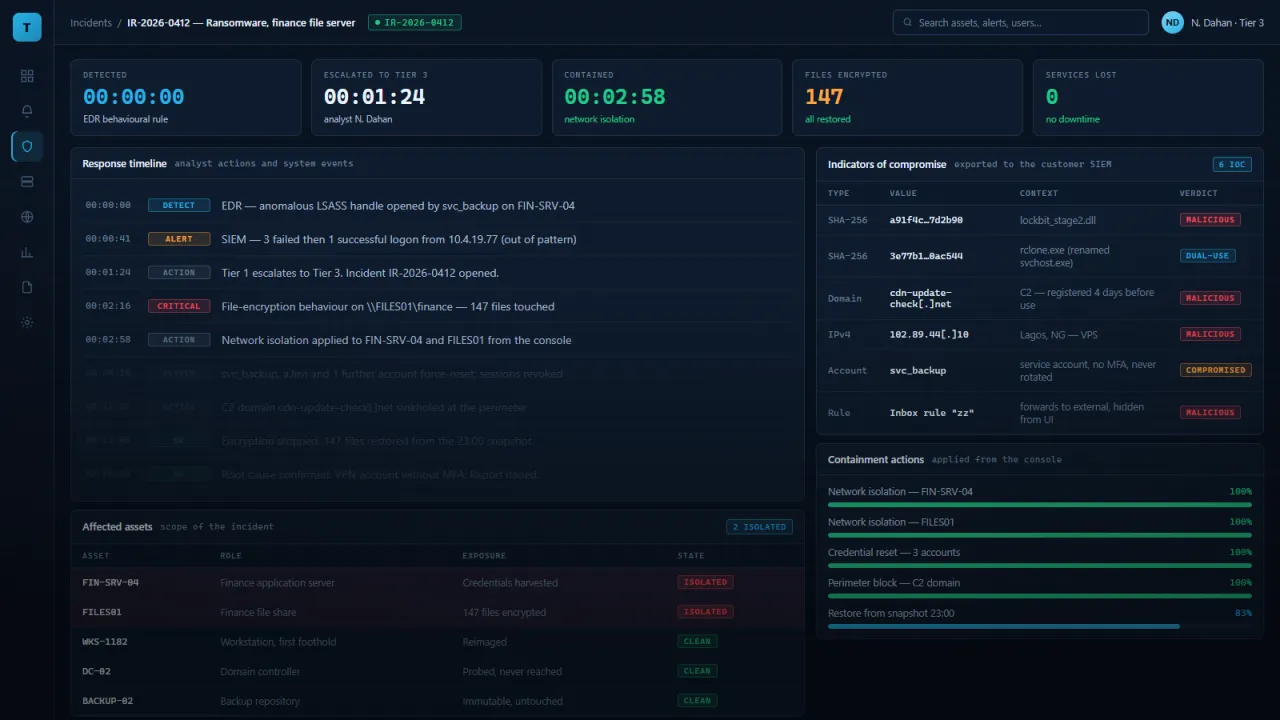
The recording shows the incident screen as the team sees it: the timeline, the affected assets, the indicators and the containment actions taken.
TripleSOC / Incidents / IR-2026-0412
Incident IR-2026-0412. Identifying data was replaced; the timings are real.
INCIDENT REPLAY · IR-2026-0412
The log, line by line.
Every line here was written by a system or by an analyst, in real time. This is what goes into the report at the end.
TripleSOC · IR-2026-0412 · ransomwareCONTAINED
DETECTEDR: anomalous LSASS memory access by svc_backup on FIN-SRV-04
ALERTSIEM: three failed logons then one success from 10.4.19.77 — out of pattern
ACTIONTier 1 escalates to Tier 3. Incident IR-2026-0412 opened.
CRITICALFile-encryption behaviour on FILES01\finance — 147 files touched
ACTIONNetwork isolation applied to FIN-SRV-04 and FILES01 from the console
ACTIONThree accounts force-reset; every session revoked
ACTIONC2 domain cdn-update-check[.]net blocked at the perimeter
CONTAINEDEncryption stopped. All 147 files restored from the 23:00 snapshot.
CONTAINEDRoot cause: a VPN account with no MFA. Report delivered to the customer.
A real incident at one of our customers, published with their consent. Identifying details were changed; the timings were not.
The report
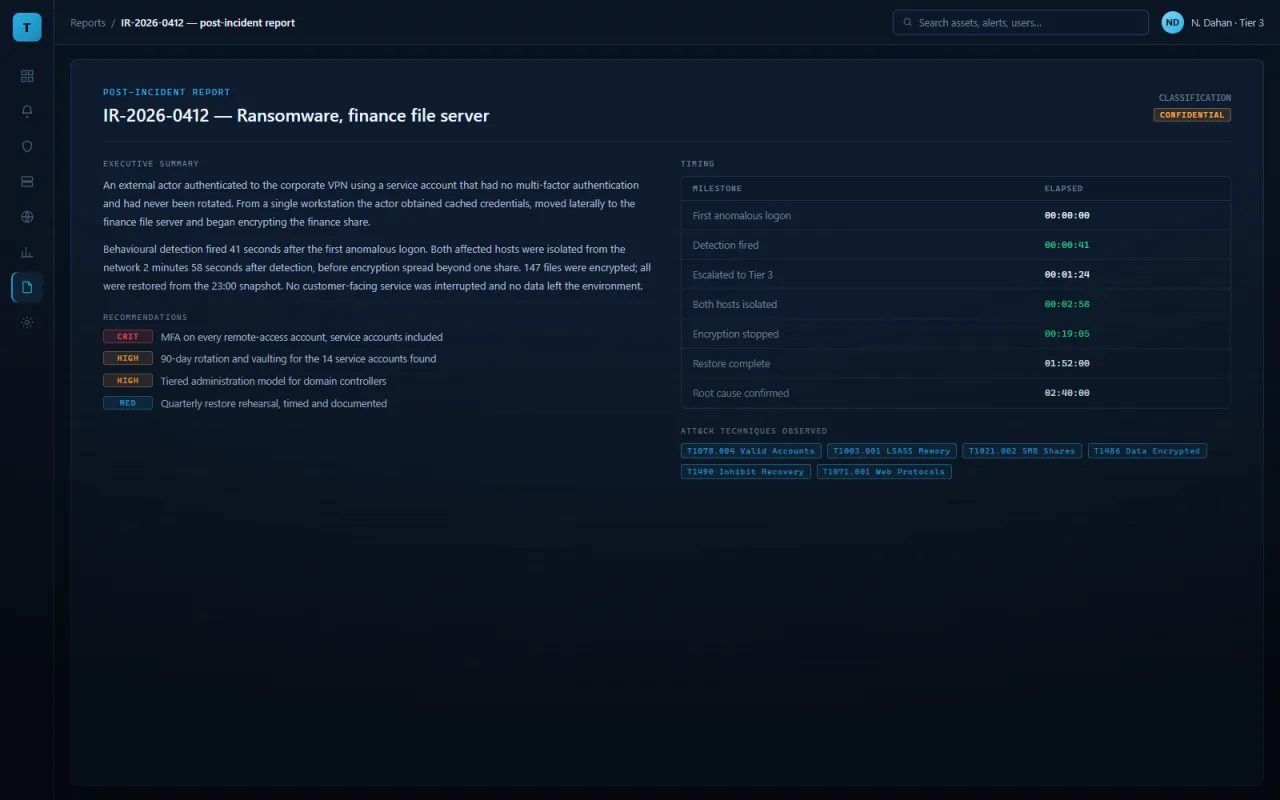
The report you get at the end.
Not a three-sentence summary. A full report: an executive summary in language management can act on, an exact timeline, indicators of compromise you can feed into your own systems, the techniques mapped to MITRE ATT&CK, and a severity-ranked list of recommendations.
It is also the document that answers the regulator and the insurer.
What decides an incident in the end is not how fast it was detected, but how fast it was stopped.
Local authority
Ransomware stopped before it spread
Situation
A VPN logon from a service account with no MFA, at 02:40. The authority runs resident services that cannot go down.
Action
Two servers isolated in under three minutes, credentials reset, the command channel blocked.
Outcome
Not one resident service was interrupted, and no ransom was paid.
41Seconds to detect
2:58Minutes to contain
0Services lost
Law firm
An email leak stopped the same day
Situation
A forwarding rule was created and hidden inside a senior partner’s mailbox. Every incoming message was copied to an external address.
Action
The rule was found and removed, MFA enforced across every mailbox, and 88 further mailboxes swept.
Outcome
Not one client document left the firm. The disclosure duty was assessed and did not trigger.
88Mailboxes swept
0Days to discovery
0Documents leaked
Industrial manufacturer
The supplier was breached; the customer was not
Situation
A subcontractor’s remote access was used to try to reach the operational (OT) network.
Action
Supplier access cut, the OT network segmented, and a supply-chain review run across all 34 suppliers.
Outcome
The production lines kept running throughout.
34Suppliers reviewed
7Minutes to block
0Hours of lost production
Questions asked in the middle of an incident.
We are not your customer. Will you step in?
Yes. The line takes emergency calls from organisations that are not customers. We start with a short diagnostic call and step in from there.
I already shut the servers down. Did I ruin everything?
No. It makes things harder, but a lot of evidence survives on disk, in logs and in perimeter systems. Tell us exactly what you shut down, and when.
The attackers want a ransom. Should we pay?
That is the organisation’s decision, not ours, and it has legal aspects too. We are experienced in negotiation events and will help you weigh it — including how much their decryption key is actually worth.
How fast do you respond?
Retainer customers have a guaranteed response time in the agreement. For a new call, an analyst is on the line within minutes, and the scope of engagement is decided on that call.
Do we have to report to a regulator?
It depends on the type of data and the sector. We provide the factual basis the reporting decision rests on, and the report that is actually filed.
Emergency line · 24/7/365
Under attack? Do not shut anything down. Call.
Shutting a machine down wipes volatile memory — and part of the evidence with it. Disconnect from the network if you can, delete nothing, and call. A senior analyst is on the line within 15 minutes, customer or not.